47 Points of Failure Avoided. Zero People Required.

In our last post, we introduced the Agentic Product Catalog Manager. Today, we're going to walk through what actually happens between "import" and "published" — and count every place where things go wrong.
The Scenario
You're a brand. A supplier just sent you a spreadsheet with 5,000 products. You need those products in your catalog — enriched, translated, validated, and live on your storefront. This isn't an unusual ask. This is Tuesday.
The question isn't whether the work gets done. It always gets done — eventually. The question is how many decisions have to be made by a human to get there, and how many of those decisions are places where quality breaks down.
Let's count.
The Traditional PIM Path
In a traditional PIM, every stage of this journey requires a different person making manual decisions. Each decision is a potential point of failure — a wrong type selected, a duplicate attribute created, an inconsistent translation, a missed validation rule. Here's the full picture:
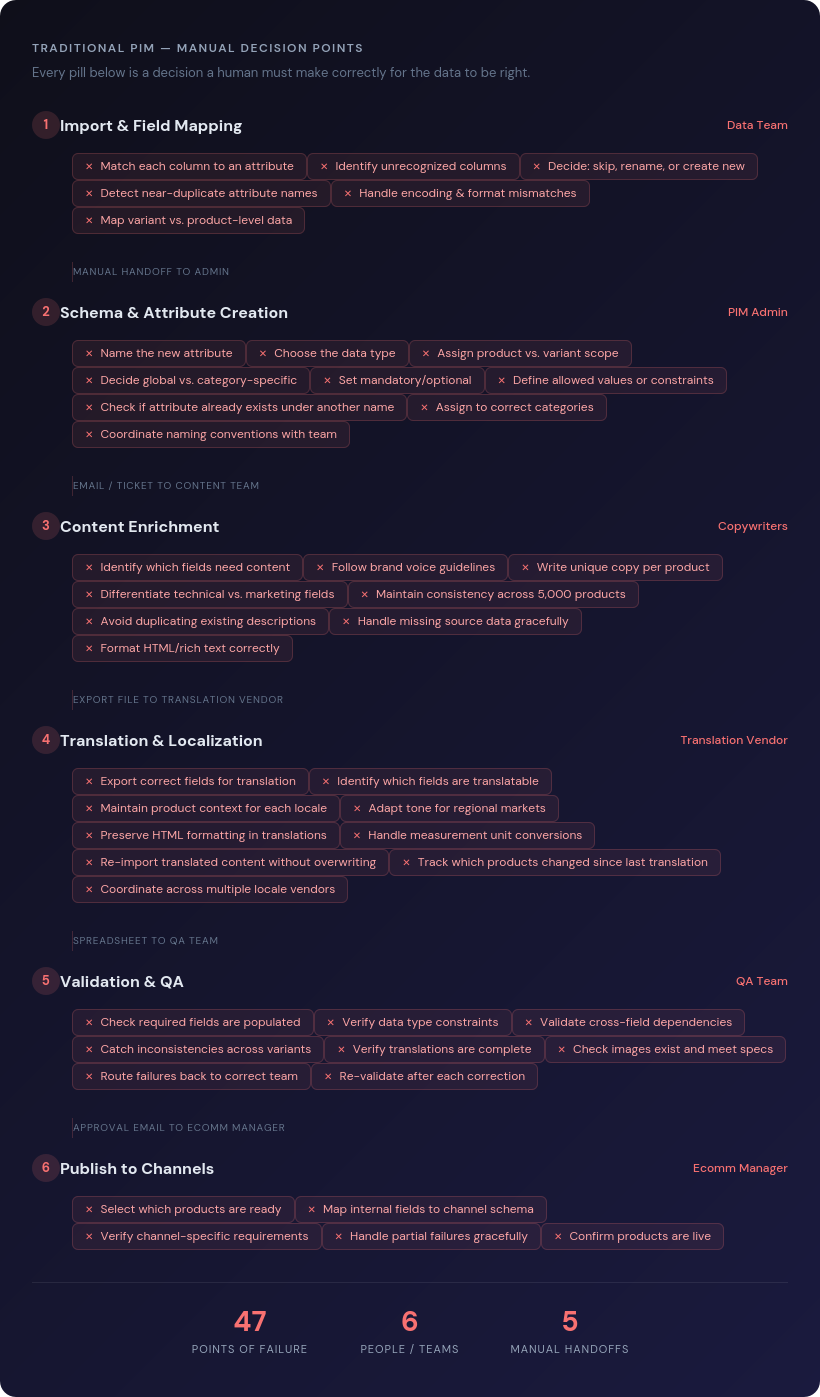
Forty-seven decisions. Six different people or teams. Five manual handoffs where context is lost, files are emailed, and nobody knows whether the upstream work is actually done. Every single pill in that diagram is a place where a human can make the wrong call — and nobody catches it until a customer sees broken data on your storefront.
And here's what makes it worse: these aren't one-time decisions. Every time a new supplier sends a file, every time your catalog changes, every time you add a market or a channel — you run the entire gauntlet again. The same 47 failure points, the same 6 people, the same manual handoffs.
The Same Scenario. No Gauntlet.
Now the same 5,000 products, the same supplier spreadsheet, the same destination. But instead of six people navigating 47 decision points, the system handles it.
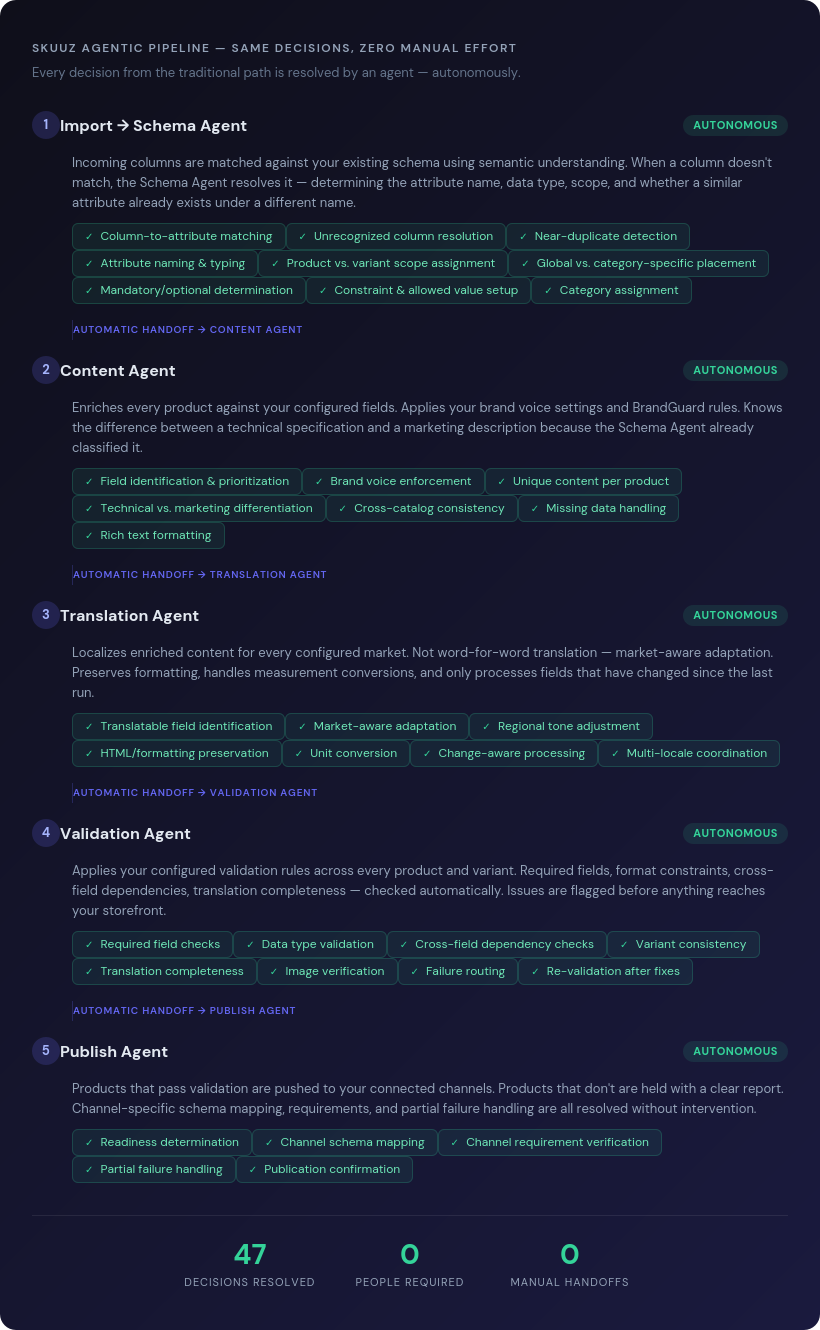
Same Decisions. Different Decision-Maker.
Count the green pills. They're the same decisions as the red ones — we didn't remove any complexity from the process. The data still needs to be mapped. Attributes still need to be created with the right type, scope, and category placement. Content still needs to respect your brand voice. Translations still need to be market-aware. Validation still needs to catch every edge case.
The difference is who makes the decision.
In a traditional PIM, those 47 decisions are spread across 6 people who communicate via email, tickets, and shared spreadsheets. Each person works in isolation, with no awareness of what happened upstream or what's expected downstream. When the data team maps a column incorrectly, the copywriter inherits the mistake. When the copywriter formats a field wrong, the translation vendor preserves the error. When the translation comes back with broken HTML, QA catches it — and sends it back to the beginning of the line.
In SKUuz, every decision is made by an agent that has full context of the decisions that came before it. The Content Agent doesn't just know that an attribute called "Tensile Strength" exists — it knows the Schema Agent classified it as a technical specification with a numeric type. So it doesn't try to write marketing copy for it. The Translation Agent knows which fields the Content Agent just updated — so it only translates what changed. The Validation Agent knows the full history of every field — so it can tell you not just that a value is missing, but which agent was responsible for populating it.
This is the real meaning of "agentic." Not "we added AI." The agents don't just execute tasks — they carry context across every stage. Every decision informs the next one. No context is lost. No handoff drops the baton.
You Set the Policy. Agents Enforce It.
Autonomous doesn't mean uncontrolled. You configure every agent. You define your brand voice. You set your validation rules. You choose which locales matter. You decide whether the Schema Agent should auto-approve new attributes or queue them for your review. Every decision the system makes is visible, auditable, and reversible.
But you're not making 47 individual decisions per import cycle. You're setting policy once, and the agents enforce it at scale — whether you're importing 50 products or 500,000.
This Isn't a Roadmap
We're not describing something we plan to build. This pipeline — import, schema resolution, content enrichment, translation, validation, publish — is live. It's running. The agent mesh that coordinates these handoffs is deployed and processing real product data today.
Forty-seven points of failure, eliminated.
Full Agentic Product Data Management is here.
AI-First Product Catalog Management
SKUuz is the AI-powered PIM built for Shopify merchants. Enrich product data with AI-generated descriptions, manage products and variants at scale, bulk-edit in a spreadsheet-style grid, and publish to Shopify with one click. Stop wrestling with spreadsheets — let AI do the heavy lifting.