The Confusion Around Agentic PIM
The race to conquer AI has hit a fever pitch, with every software provider on the planet claiming to be the next big AI company and every hardware company trying to make new gadgets that incorporate AI. In this mad rush, the reality of what AI is and is not has gotten lost. There are so many opinions on the difference between automation and agency that no one definition fits, and in this gap confusion reigns.
So today we are going to give you our opinion on the differences between automation, AI, and Agentic systems in a no-nonsense, easy-to-digest way. No marketing speak.... No technical jargon... Just a good clear definition of what we think so you can understand why SKUuz is different.
The Difference Between AI and Automation?
Believe it or not, most of what is being sold today as AI is actually just automation. This is especially true when you talk about the dreaded vibe coders. (Writer's note: We incorporate Vibe Coding Skills with other business functions.) See the infographic below to understand the difference between Automation and AI.
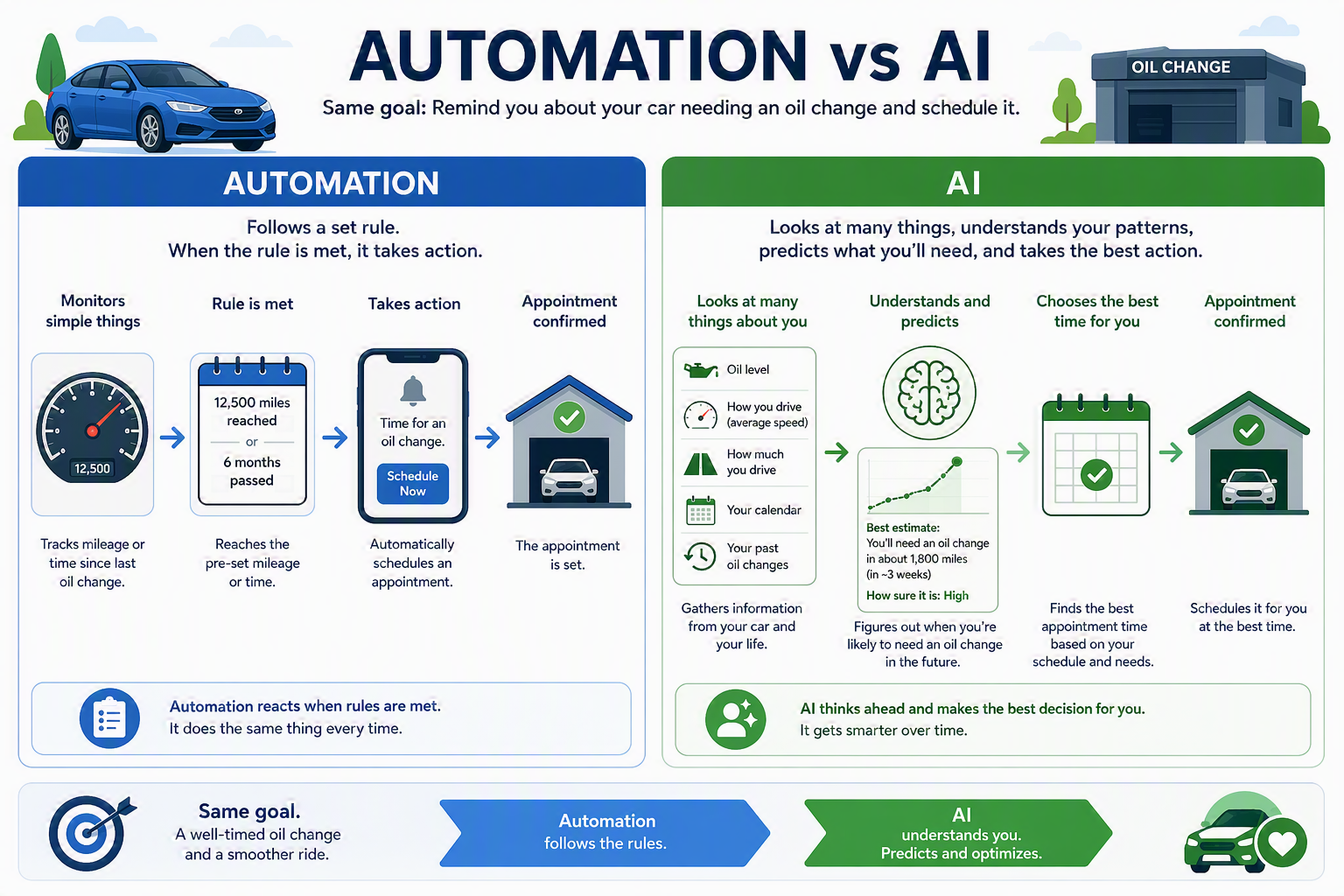
Automation takes something you're already doing and makes a machine do it. It waits for a scheduled event or monitors simple data for triggers and then does an action. It waits for 6 months to pass since your last oil change, looks at the mileage on your car, and schedules an oil change.
AI takes data in to make an intelligent decision, and then performs the same activity as the automation, but in a more intelligent manner. Instead of just waiting 6 months to schedule an oil change, it monitors your oil level, how you drive, how much you drive, and reads your calendar to anticipate when you are going to need that oil change. Then it schedules the oil change. It makes a decision on when to schedule that oil change, not just wait for a triggering event like time or miles elapsed.
80% of vibe coded solutions are automations that people BUILT with AI, so they call them AI. The value in AI is in making the decision for you, but not every decision requires AI. It isn't until the AI is in charge of making an actual decision that it becomes AI-powered. Simply hooking up a workflow to an LLM to generate content is not really AI - There is a trigger (the workflow steps) that generates the content based on a prompt. There is no decision. This is just semantic generation through workflow. It is automation. And that is what most of the PIMs do.
There is value in that automation, in that the copywriting process is sped up. Products get to market faster. A small part of AI is used to generate the content, but the smaller part possible. We could talk about vector databases and algorithms, but we promised not to be technical in this post. So leave it to say these bolt-on content generation services barely qualify as AI.
The Different Between AI And Agency
With that understanding, let's talk about the difference between bolting AI onto a PIM platform and actual Agentic AI. There is a significant difference, and that difference is not commonly agreed upon by just about anybody. Understand that you are getting our opinion here at SKUuz, and that we strongly believe you should form your own opinion. That said,. our opinion is right and you should listen to us. (Yes, we do have a sense of humor here at SKUuz.)
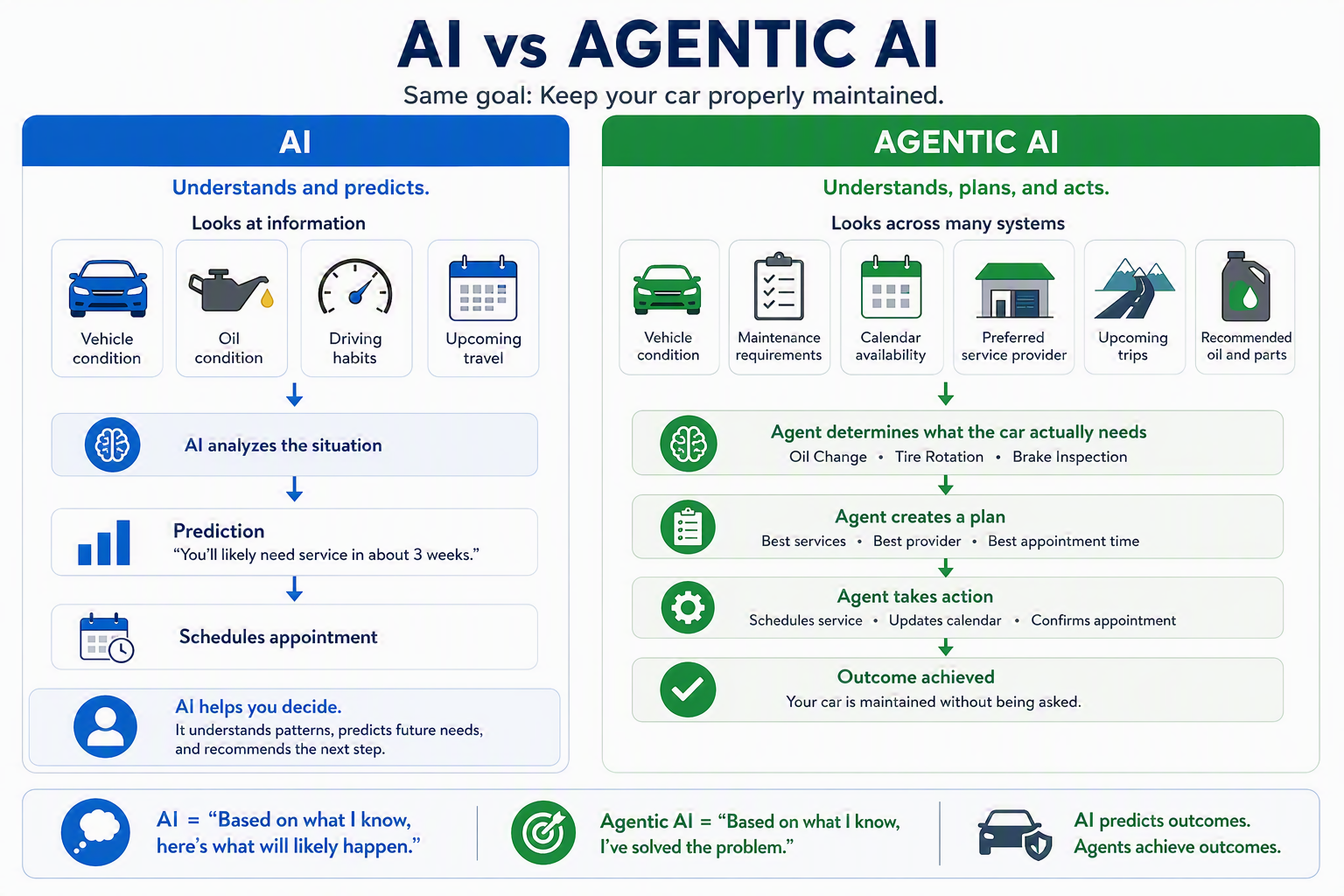
The main difference between AI and an Agent is that the Agent acts on it's own. Where AI makes a decision, Agents look for the question. In our oil change example, the end goal of AI is to figure out when is the best time to schedule that oil change. It is the one goal for the AI. If you want to handle deeper functions with the AI, you have to ask it a different question.
Agents change this. You can prompt an Agent with a goal like "Handle all scheduling of maintenance on my car", and the Agent examines what that means. After it determines what the goal means, it will monitor all the proper data points that could lead to ANY vehicle maintenance. The goal of the Agent isn't to schedule an oil change: It's to ensure the car keeps running, and deciding how to do so.
PIM, AI, and Agents
At SKUuz, we have been around PIM a long time. Like, way too long. And we have seen fads come and go. Auto-Classification was a big deal 10 years ago. Syndication became mainstream 7 years ago. Content Delivery Networks for images in PIM started becoming standard 3 years ago. The most common reaction among legacy PIM tools is to build or buy a secondary tool and slap it on the side of the existing tool.
The rush to lead in AI has been no different. The enterprise PIMs connected up to external LLMs to generate content in an automated fashion. When simple LLM connections didn't scale to hundreds or thousands of products, they added them to their workflow. And that was that. They considered those workflow connections to be Agents, but they still required a trigger. The workflow triggered the system to push content through the LLM to generate content. Without the workflow trigger, they required human interaction to kick them off.
That is automation, not Agency. As stated above, that's semantic content generation with a workflow trigger. However, to reach true Agentic AI the legacy PIMs would have to re-think their entire platforms. Agency requires that the Agents can act independent of an action, communicate with each other, and achieve a goal of faster, better data quality. AI tied to workflow doesn't accomplish that goal. Those aren't Agents. They are automation.
Agents have goals. They are free to make decisions about how to reach those goals. They talk to other Agents when they need help. They monitor and react. They are always watching instead of waiting in their place in line. They think and decide, not generate content because they're told to. Agents are intelligence, where AI Content Generation is just automation.
SKUuz is truly. We didn't start with a legacy platform that we had to rebuild to be Agentic. Our philosophy from the start was to build a truly Agentic platform. To accomplish this required a philosophy switch: In traditional PIM the database is the backbone, in SKUuz the Agents are the backbone. Here is how we meet the goal of Agency:
SKUuz Command Center Agent (We call it CC) performs Natural Language Processing much like a chat bot, and responds similar to a chatbot. However, it is much smarter than a simple chat bot. It decides based on the question or statement asked which Agent to route the request to. It does no actions inside the platform: It tells the other Agents there is work to do.
Each SKUuz Agent has a goal set. It functions in two ways - Waiting for CC to give it a task, or watch the data to see if they need to interject. They are not slaves to a workflow. They each act independently of each other to reach a specific goal, like managing the schema, normalizing imports, or generating or translating content.
SKUuz Agents talk amongst themselves. If an Agent comes across a requirement that is part of another Agent's function set, it passes the baton to that Agent. The Agent DECIDES which other Agents are necessary without waiting for a workflow trigger or a manual intervention.
SKUuz Agents will use CC to request further information about an action. CC Interprets what the Agent asked and gives a human-readable response to the user. Whether that Agent requires more information than was provided to complete a task or something requires an approval, CC and the other Agents are always talking to each other. SKUuz Agents all work together in whatever order and style makes sense to get your products to market with better, cleaner, more complete data in far less time.
This is vitally important...... SKUuz can be implemented in a manner that you NEVER have to touch the data in SKUuz. If enough data is present at the outset of an import from another system (which can be monitored by an Agent), the SKUuz Agents can take that data all the way through publish. You can set each Agent to require an approval, but you can also set each Agent to auto-approve. It's all about the level of comfort you have with AI content. If you want SKUuz to do all the work, SKUuz CAN do all the work.d
SKUuz Agents do more: If you give CC an import file, CC will send the schema to the Schema Agent for mapping and schema changes, normalize the data in the Import Agent, classify the product with the Categorization Agent, translation the data through the Translation Agent, generate meta data for images, validate that all the data is complete and meets all your governance rules with the Validation Agent, and assign the product to your web hierarchy in the Publish Hub with the Publish Agent.
This is not possible with any other PIM tool on the market. The Enterprise PIMs will charge you $100,000 a year for automation. You can get everything SKUuz offers for less than $10,000 a year. Enterprise PIMs promise to cut your time to market in half: SKUuz will help you get products to market in minutes.
Want to see what we're talking about? You can install SKUuz directly through the Shopify and WooCommerce app stores. You get a 14 day free trial, we upload your existing schema (No implementation costs), help you set up your Agents with in-app onboarding, and can push your entire product assortment back out of the tool with optimized content, better meta data on your images, translations performed in context of the locale they are associated to, faster than anyone else.
Want to know more? We are always available to talk at info@skuuz.com. We love talking about data. We love talking about AI. We love showing off our Agents. Come see the difference that SKUuz, the first truly Agentic PIM, can make for your product data.
AI-First Product Catalog Management
SKUuz is the AI-powered PIM built for Shopify merchants. Enrich product data with AI-generated descriptions, manage products and variants at scale, bulk-edit in a spreadsheet-style grid, and publish to Shopify with one click. Stop wrestling with spreadsheets — let AI do the heavy lifting.